|
Cite as: 233 Or. 178, 376 P.2d 100 |
SUPREME COURT OF OREGON
Margaret K. THORNBURG, and Margaret K. Thornburg, Executrix of the Estate of
Bernhart Mesch Thornburg,
also known as Bernard M. Thornburg, deceased,
Appellants,
v.
The PORT OF PORTLAND, a Municipal Corporation, Respondent.
Decided Nov. 7, 1962
COUNSEL:
James H. Clarke, Portland, for appellants. Wayne Hilliard, Cecil H. Greene, and Koerner, Young, McColloch & Dezendorf, Portland, on the briefs.
Lofton L. Tatum, Portland, for respondent. John G. Holden and Wood, Wood, Tatum, Mosser & Brooke, Portland, on the brief.
GOODWIN, Justice.
A trial jury denied plaintiffs the compensation which they sought in an action for 'inverse condemnation'. [FN 1] In so doing, the jury necessarily found that the Port of Portland had not taken the plaintiff's property. The plaintiffs appeal.
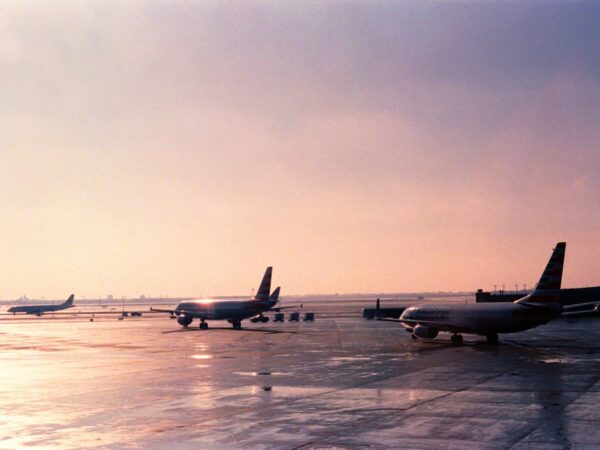
The Port of Portland owns and operates the Portland International Airport. It has the power of eminent domain. It has used this power to surround itself with a substantial curtilage, but its formal acquisition stopped short of the land of the plaintiffs. For the purposes of this case, the parties have assumed that the Port is immune from ordinary tort liability. Further, it is conceded that injunctive relief would not be in the public interest. Aircraft are not ordinarily operated by the Port itself, but by third parties which use its facilities. Air navigation and other related operations are, for all practical purposes, regulated by a federal agency. The Port merely holds the airport open to the flying public.
The plaintiffs own and reside in a dwelling house located about 6,000 feet beyond the end of one runway and directly under the glide path of aircraft using it. Their land lies about 1,500 feet beyond the end of a second runway, but about 1,000 feet to one side of the glide path of aircraft using that runway.
The plaintiffs contend that flights from both runways have resulted in a taking of their property. Their principal complaint is that the noise from jet aircraft makes their land unusable. The jets use a runway the center line of which, if extended, would pass about 1,000 feet to one side of the plaintiffs' land. Some planes pass directly over the plaintiffs' land, but these are not, for the most part, the civilian and military jets which cause the most noise.
The plaintiffs' case proceeded on two theories: (1) Systematic flights directly over their land cause a substantial interference with their use and enjoyment of that land. This interference constitutes a nuisance. Such a nuisance, if persisted in by a private party, could ripen into a prescription. Such a continuing nuisance, when maintained by government, amounts to the taking of an easement, or, more precisely, presents a jury question whether there is a taking. (2) Systematic flights which pass close to their land, even though not directly overhead, likewise constitute the taking of an easement, for the same reasons, and upon the same authority.
The Port of Portland contends that its activities do not constitute the taking of easements in the plaintiffs' land. The Port argues: (1) The plaintiffs have no right to exclude or protest flights directly over their land, if such flights are so high as to be in the public domain, i.e., within navigable airspace as defined by federal law. [FN 2] (2) The plaintiffs have no right to protest flights which do not cross the airspace above their land, since these could commit no trespass in any event. Accordingly, the Port contends, there is no interference with any legally protected interest of the plaintiffs and thus no taking of any property for which the plaintiffs are entitled to compensation. In short, the Port's theory is that the plaintiffs must endure the noise of the nearby airport with the same forbearance that is required of those who live near highways and railroads. The Port's arguments, supported as they are by substantial authority, prevailed in the lower court, even though they were not entirely responsive to the plaintiffs' case. (The plaintiffs founded their case upon a nuisance theory; the defendant answered that there was no trespass.)
There is no doubt that noise can be a nuisance. See cases collected in Annotation, 44 A.L.R.2d 1381, 1394 (1953) (dance halls); Lloyd, Noise As a Nuisance, 82 Pa.L.Rev. 567 (1934); de Funiak, Equitable Relief Against Nuisances, 38 Ky.L.J. 223 (1949); and Notes, 15 Or.L.Rev. 268 (1936). At common law, one could obtain a prescriptive right to impose an unreasonable noise upon one's neighbor, and hence an easement for a nuisance. Sturges v. Bridgman, L.R. 11 Ch.D. 852 (1879); Restatement, Property, s 451, Comment a. (The authorities do not all agree about when the prescriptive period begins to run, [FN 3] but that problem is not before us now.) It is clear that freedom from unreasonable noise is a right which, in a proper case, the law will protect. On similar principles, offensive smells are treated as nuisances for which a remedy will lie. See cases collected in Annotation, 18 A.L.R.2d 1033 (1950) (slaughterhouse). It is equally clear that a reasonable volume of noise (like a reasonable olfactory insult from industrial odors) must be endured as the price of living in a modern industrial society. See generally Restatement, Torts, ss 822-831. Freedom from noise can be a legally protected right.
A taking within the meaning of Oregon Constitution, Art. I, s. 18, has been defined as 'any destruction, restriction, or interruption of the common and necessary use and enjoyment of the property of a person for a public purpose * * *.' Morrison v. Clackamas County, 141 Or. 564, 568, 18 P.2d 814, 816 (1933). See Note, 16 Or.L.Rev. 155 (1937). The definition from Morrison v. Clackamas County, supra, is broad enough to cover a continuing nuisance, and hence the plaintiffs' case, unless there is some policy reason for limiting its application.
Since United States v. Causby, 328 U.S. 256, 66 S.Ct. 1062, 90 L.Ed. 1206 (1946), and particularly since Griggs v. Allegheny County, 369 U.S. 84, 82 S.Ct. 531, 7 L.Ed.2d 585 (1962), we know that easements can be taken by repeated low-level flights over private land. Such easements have been found in actions against the federal government (Causby) and in actions against municipal corporations (Griggs). When such easements are said to have been taken, compensation must be paid to the owners of the lands thus burdened. This much appears to be settled.
It is not so well settled, however, that the easements discussed in the Causby and Griggs cases are easements to impose upon lands near an airport a servitude of noise. Courts operating upon the theory that repeated trespasses form the basis of the easement have not found it necessary to decide whether a repeated nuisance, which may or may not have been an accompaniment of a trespass, could equally give rise to a servitude upon neighboring land. It must be remembered that in both the Causby and Griggs cases the flights were virtually at tree-top level. Accordingly, both decisions could perhaps be supported on trespass theories exclusively. Following the Causby case, several federal district courts held that while repeated flights at low levels directly over private land may amount to a taking for which compensation must be paid, repeated flights nearby but not directly overhead must be endured as mere 'damages' which, for various reasons, may not be compensable. See, e.g., Moore v. United States, 185 F.Supp. 399 (N.D.Tex.1960); Freeman v. United States, 167 F.Supp. 541 (W.D.Okl.1958); and see Cheskov v. Port of Seattle, 55 Wash.2d 416, 348 P.2d 673 (1960), where the court found no taking, but held that damages might be recoverable in a proper case under the Washington constitution. [FN 4]
As we noted in a recent case which involved a different aspect of the airport problem, [FN 5] some of the decisions reveal internal ambivalence with reference to the theory upon which they proceed. In perhaps the leading case, United States v. Causby, supra, the court used language appropriate to the law of trespass more or less interchangeably with language appropriate to the law of nuisance. [FN 6] It appears that the majority in the Batten case accepted the rule that only a trespass in the airspace directly overhead can give rise to an action for a taking, and that nuisance principles ought not to be applied in actions against the government. This may be a cogent policy argument, but it does violence to the law of servitudes.
[FN 6] The case says that the landowner owns at least as much of the space above the ground as he can occupy or use in connection with the land, and that the landowner as an incident of ownership has a claim to it and invasions of it are in the same category as invasions of the surface. 328 U.S. at 264, 265, 66 S.Ct. 1062. In the same opinion, the court also says that '[f]lights over private land are not a taking, unless they are so law and so frequent as to be a direct and immediate interference with the enjoyment and use of the land. * * *' 328 U.S. at 266, 66 S.Ct. at 1068. The commingling of trespass and nuisance language has been noted elsewhere. See 51 Northw.U.L.Rev. 346 (1962).
While not every wrong committed by government will amount to a taking of private property, there are some wrongs which do constitute a taking. See, e.g., Cereghino et al. v. State by and through State Hwy. Comm., 74 Adv.Sh. 547, 370 P.2d 694 (1962), and Moeller et ux. v. Multnomah County, supra. Many of these wrongs involve trespassory activities. The inquiry must not beg the question, however, whether a nuisance can also amount to a taking. Whether a nuisance has, in fact, produced the results alleged by the plaintiff in this case is another matter; first we must decide whether a nuisance can ever constitute a taking. If there is a taking, then what is taken must be paid for. Armstrong v. United States, 364 U.S. 40, 48, 80 S.Ct. 1563, 4 L.Ed.2d 1554 (1960). And see Annotation, 84 A.L.R.2d 348, Eminent Domain--View--Interference (1962).
The subject matter of inverse condemnation is always private roperty. Narrowed down to a meaningful definition for the purposes of this case, however, the only 'property' right of the possessor of land which has any value is his ability to use and enjoy his land. This is true whatever estate the possessor holds, whether in fee, or for life, or for years, or merely an incorporeal interest such as an easement or profit. See Ackerman v. Port of Seattle, 55 Wash.2d 400, 348 P.2d 664, 77 A.L.R.2d 1344 (1960). If the government substantially deprives the owner of the use of his land, such deprivation is a taking for which the government must pay. [FN 7] Cereghino et al. v. State Hwy. Comm., supra; Ackerman v. Port of Seattle, supra. If, on the other hand, the government merely commits some tort which does not deprive the owner of the use of his land, then there is no taking. [FN 8]
FN8. The general rule is thus stated by Nichols:
'* * * [W]hen a municipal or a public service corporation, or other party to whom the power of eminent domain can be constitutionally delegated, inflicts injury upon private land under authority of and in compliance with an act of the legislature, and there has been no want of reasonable care or skill in the execution of the power, such party is not liable in an action at law for such injury, even though the same act if done without legislative sanction would be actionable, unless the injury is of such a character as to deprive the owner of the use and possession of his land, or compensation is required by special statutory or constitutional provision whenever property is damaged by the construction of a public improvement [citing cases].'
2 Nichols, Eminent Domain 293, s 6.38(1). See also 4 Nichols, Eminent Domain 476, s 14.1(1), and cases collected in the annotation thereto.
It now becomes relevant to consider whether a jury ought to be permitted to find that a given nuisance is so aggravated as to be a taking when the perpetrator of the nuisance happens to be the government. The Port argues that the plight of the plaintiffs in this case is indistinguishable from that of thousands of their fellow countrymen whose homes abut highways and railroads and who endure the noise without complaint. Granting the similarity, it must be noted, however, that the matter is one of degree. [FN 9] We do not decide that the positions of the parties are the same. The Port points to our previous decisions in support of the proposition that nuisance (nontrespassory) invasions by government are not compensable. The cases cited by the Port did not, however, hold that a nuisance so aggravated as to amount to a complete ouster or deprivation of the beneficial use of property was not a taking. That question does not appear to have been passed upon by our court. But cf. Wilson v. City of Portland, 132 Or. 509, 514, 285 P. 1030 (1930), where there is dictum to the effect that nontrespassory incursions give rise to no liability. There are cases elsewhere which tend to support the Port's theory that nuisances, when committed by government, are 'legal' and therefore can never be a taking in the constitutional sense, but must always be endured with fortitude. Indeed, some authorities hold that the king can do no wrong and that the government never perpetrates a nuisance. See cases noted in 66 C.J.S. Nuisances s 17, p. 761. Again, 'lawful' nuisances have been held to be of such public desirability (utility) that only those portions of the invasion that could be severed from the whole and characterized as trespass could be considered in an action for damages. See, e. g., Richards v. Washington Terminal Co., 233 U.S. 546, 34 S.Ct. 654, 58 L.Ed. 1088, L.R.A.1915A, 887 (1914), holding that railroad noises and smoke (but not soot) must be endured where the conduct that created the nuisance is in the public interest and has been encouraged by law. The reason for assigning mystical power to trespass quare clausum fregit is elusive. But Richards v. Washington Terminal Co. did not say that the public interest demands that all governmentally approved activities (except trespass) be endured without compensation. We have found no case which goes that far, and we doubt that the constitutional right to compensation can be so construed.